
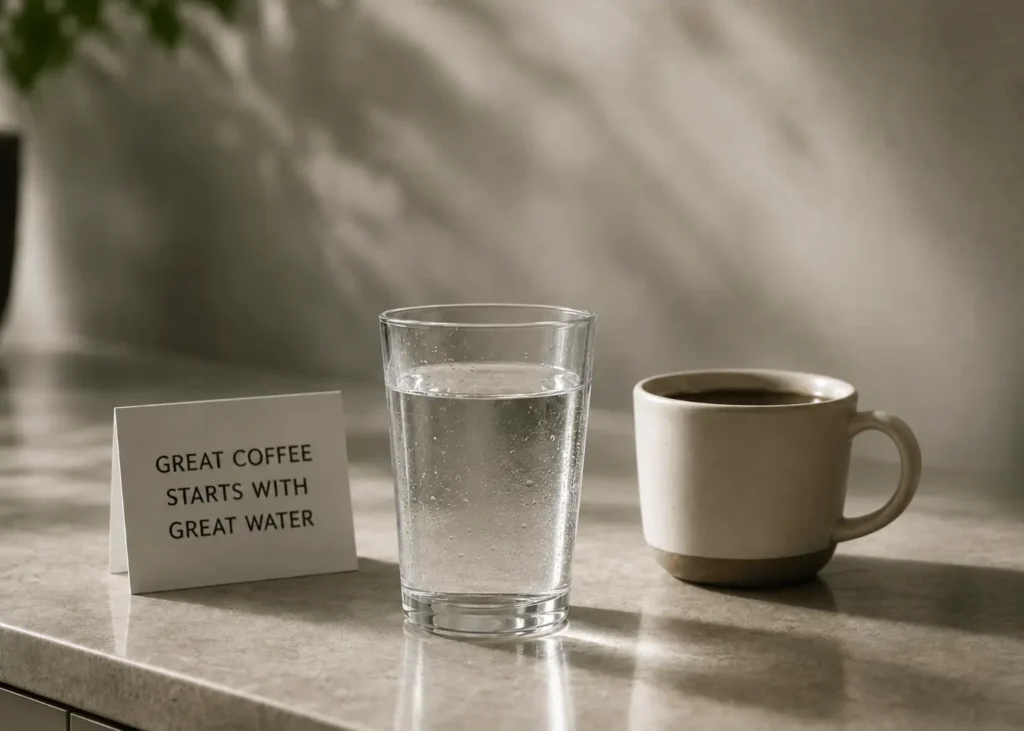
After analyzing the water quality reports from the City of Springfield, here’s a how the findings connect to actual coffee flavor.
Springfield’s water supply has three major “problems” that impact your coffee:
1. High and variable alkalinity. This suppresses your coffee’s natural acidity.
2. A substantial disinfectant residual. This risks chemical or medicinal flavors seeping into the brew.
3. Moderate-to-high hardness paired with alkalinity. This raises scale risk.
They’re not massive things to write home about.
The amount of chlorine in tap water would dramatically impact the flavor – giving it a chemical taste.
Of course, this isn’t an issue. Springfield’s tap water meets federal EPA regulations.
How Springfield Tap Water Impacts Coffee Brew Flavor
- Mutes fruity notes
- Reduces brightness
- Blends flavors together
- Emphasizes bitterness
- Creates a flatter finish
- Adds a chalky or mineral edge
- Reduces sweetness clarity
- Risks chemical off-flavors
- Sometimes adds earthy flavors
- Produces inconsistent cups
Tap Water Quality Metrics in Springfield, Missouri
Average hardness: 8.1 GPG, or 137.3 mg/L as CaCO₃
Range: 4.3 to 12.0 GPG, or 73.8 to 205.8 mg/L
Alkalinity is THE Major Issue

SCA Water Quality Handbook published by the Specialty Coffee Association (SCA). Their “good” alkalinity score is between 40-70 ppm. That’s 2.3 to 5.3 times more acid-neutralizing capacity.
Springfield’s water alkalinity is between 92 to 211.
Low-alkalinity water helps preserve more brightness and “fruity” flavor within coffee.
High-alkalinity water, however, makes the same coffee taste flatter, darker, and more bitter.
This is (my personal conspiracy theory), in part, why so many of the drip coffee brews in Springfield taste very bitter.
High alkalinity means that light and medium roasts will result in:
- Fruity flavors like citrus, berries, peach, or cherry tasting weaker.
- Floral aromas becoming harder to notice.
- The coffee tasting less lively or crisp.
- Different flavor notes blending together instead of standing out.
- Bitter, roasted, or smoky flavors becoming easier to notice.
- The finish might taste dull, heavy, or slightly chalky.
Keep this in mind: Coffee acidity doesn’t come from one compound. Citric, malic, acetic, lactic, quinic, phosphoric, chlorogenic, and other acids contribute different tastes, aromas, and tactile sensations.
Even professional coffee tasters can’t really identify the acid concentration levels.
The Boring Science Behind Water Quality Testing
Calcium and magnesium interact with coffee molecules. These change the mouthfeel and perceived flavor balance.
Bicarbonate
- Raises alkalinity
- Neutralizes coffee acids
- Increases carbonate-scale potential
Chloride
- Adds mineral or salty character at high concentrations
- Contributes little alkalinity
- Raises conductivity and ionic strength
- High levels increase corrosion concerns in some metal systems
Sulfate
- Adds hardness when paired with calcium or magnesium
- Supplies little acid buffering
- Often produces a firmer, drier mineral impression at high concentrations
- Does not form calcium carbonate scale through the same pathway as bicarbonate
In Summary
Hardness influences mineral interactions.
Alkalinity controls acid buffering
Disinfectants add odor
Trace metals promote off-flavors and oxidation
Bicarbonate hardness drives scale.
Quality coffee will use water that balances all five.
Tap water influences the coffee through four main pathways:
- Solvent behavior: how coffee compounds move from the grounds into the water.
- Acid buffering: how much of coffee’s acidity stays perceptible.
- Direct sensory input: including chlorine, salts, and metals.
- Equipment chemistry: especially mineral scale and corrosion.
How Coffee Brewing and Tap Water Interact
Coffee brewing involves far more than dissolving acids.
Water extracts or disperses:
- Caffeine
- Organic acids
- Chlorogenic acids and their degradation products
- Maillard-reaction products
- Melanoidins
- Volatile aroma compounds
- Lipids and colloidal droplets
- Polysaccharides
- Minerals already present in the roasted coffee
Different compounds move at different rates. Temperature, particle size, contact time, agitation, roast development, and concentration gradients will influence those rates.
Should I Boil the Tap Water Before Brewing Coffee?
Boiling the water at extremely hot temperatures won’t change the compounds that comprise it.
Should I Boil the Coffee Water Before Drinking?
Again, this won’t do anything. In fact, boiling coffee increases its acidity and ruins the flavor.